Lactobacillus casei, a strain of bacterium similar to what Michael Cho and colleagues have engineered to express proteins in the hope of sparking an immune response to HIV. AJC1 via photopincc
The investigation into faked AIDS vaccine tests “followed an atypical path compared to most research misconduct cases,” an Iowa State University administrator wrote in a report last October.
The case “began with proof of research misconduct and only after considerable effort was the responsible party identified,” Charlotte Bronson, Iowa State University’s associate vice president for research and research integrity officer. Multiple researchers handled samples that later proved questionable. The research also hadn’t been published, at which point other scientists may have questioned the results.
The investigation, which led ISU scientist Dong-Pyou Han to resign, played out over nearly 10 months, starting a year ago this week. It actually began at Case Western Reserve University in Cleveland, where Han and the leader of his lab group, Michael Cho, worked before Iowa State recruited Cho.
The investigation exonerated Cho and other members of his lab, but it doesn’t erase their embarrassment and chagrin at having pursued a dead lead – and at facing questions about the federal financing that supported the research.
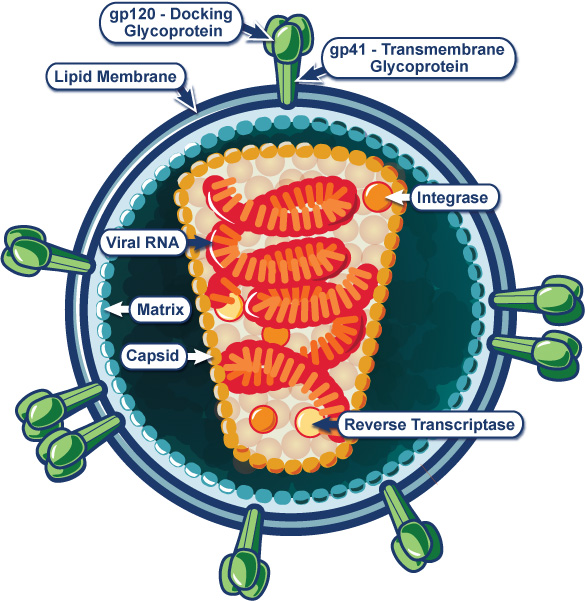
In this schematic of the Human Immunodeficiency Virus (HIV), the glycoproteins gp41 and gp120 are the base and tip, respectively, of the “spikes” protruding from the membrane. Credit: National Institute of Allergy and Infectious Diseases.
The saga of Dong-Pyou Han and his research misconduct continues.
Late last week, Iowa State University responded to my request for a report the university sent to the Office of Research Integrity (ORI) at the U.S. Department of Health and Human Services.
The documents include Han’s signed admission of how he spiked blood samples to make it appear rabbits developed antibodies to HIV, the AIDS virus.
Michael Cho, the project’s lead researcher, reported the suspected misconduct one year ago this week, and after an investigation stretching into August, pegged Han as the likely culprit. He resigned in October.
Han is the only researcher suspected in the fraud.
The Des Moines Register’s Tony Leys also received the documents – including emails concerning the investigation, which I did not request – and wrote a piece Thursday night. Another piece on Friday quotes Arthur Caplan, the go-to source when journalists need a comment on bioethics.
Leys’ initial story covers Han’s grammatically clumsy mea culpa but omits many details – including what appears to be his rationale for the whole fraud.
At the time I wrote my last entry, about Iowa State University researcher Dong-Pyou Han’s admitted research misconduct, I had an email seeking additional information out to ISU spokesman John McCarroll.
I wasn’t sure how soon McCarroll would get back to me, given the skeleton staff ISU maintains during semester break, so I went ahead with the post, which raised questions about what kind of a deal Han may have reached to settle charges that he tampered with research for an AIDS vaccine.
McCarroll’s response, just before New Year’s Day, sheds some light on those questions – but not much.
In this blog, I usually highlight Iowa science developments that don’t get a lot of attention. If something is splashed across the headlines, I’ll generally let it go or say little about it. I want to concentrate on things most of the press misses.
What happened at Iowa State University just before Christmas, however, is too big and unusual to let pass: A federal agency announced sanctions against a professor for falsifying research.
The nature of the case and what it gained the offender are unusual. Since the offiense was revealed, bloggers and commentators also have cited it to support their views on everything from vaccinations to climate change.
A typical selection from my reporter’s notebook. Can you make out any of it?
Anyone who’s seen my handwriting would have a hard time mistaking it for someone else’s. The loops and slashes that fill my reporter’s notebooks are unmistakably mine, even if they’re indecipherable to most people. (Fortunately, I can read them… mostly.)
My typing, of course, is easily legible – even though my typing is pretty terrible. I’m able to erase the typos, blank spaces, merged words and other errors.
Now it turns out that my crappy typing is just as recognizable as my crappy handwriting. In fact, we each have a characteristic typing pattern, and some Iowa State University computer researchers are capitalizing on that to strengthen information security.
It’s often how the best scientific discoveries start: When a scientist says, “Well, that’s weird.”
That was pretty much Steve Kawaler’s reaction when he saw data from Kepler-56, one of dozens of stars NASA’s Kepler space telescope flagged as likely to have orbiting planets, known as exoplanets.
Kawaler, an Iowa State University professor of physics and astronomy, is part of a committee overseeing Kepler’s asteroseismic (no, that’s not a typo) research. Asteroseismology is a lot like Earth-bound seismology, Kawaler says. “It’s the same mathematics, the same physics” describing wave propagation and response to conditions like pressure.
But with stars 3,000 light-years away, as Kepler-56 is, scientists can’t plant monitors on the surface to detect and measure waves, like they do here. Instead, astronomers watch for subtle oscillations in light from the star. The frequency and magnitude of those oscillations, combined with readings from instruments like spectrometers, can tell astronomers a lot, including the radius, mass and age of a star and how fast it rotates.
Asteroseismology and other data seemed to tell Kawaler and others in an international team something about Kepler-56 and its planets that they had never seen before.
Arun Somani with Cyence, Iowa State University’s new high-performance computer, at the Durham Center on campus. Photo by Bob Elbert, ISU News Service.
Iowa State University made a splash late last month when it rolled out its latest high-performance computer, Cyence. News releases and stories touted the $2.6 million machine’s speed: just over 183 teraflops (trillion scientific calculations per second). It would take a single human 5 million to 6 million years to do as many calculations as Cyence can do in a second, the press said.
For ISU, it’s a terrific machine – although it’s a shadow of the world-class supercomputers at Department of Energy, Chinese and European laboratories. Cyence definitely will let ISU researchers do cool things, leading to insights that will advance science.
But the releases and the stories aren’t telling the full story. And they may paint a somewhat inaccurate picture of Cyence’s capabilities.
High-energy X-ray diffraction patterns from a single grain of iodine-gadolinium-cadmium taken at Argonne National Laboratory’s powerful X-ray device, the Advanced Photon Source, with the beam parallel to the grain’s five-fold axis. Scientists can tell something about a material’s structure by the way it diffracts X-rays, with more powerful sources providing greater detail.
For this post, here’s a roundup of a few interesting Iowa science items over the last couple weeks, including obsessive-compulsive and obese mice, a new family of quasicrystals and pigeons pecking touchscreens. (In this case, shouldn’t they be called “peckscreens”?)
If you’re not in the fields associated with these projects, you may not have heard of them. As with a lot of other Iowa science, they didn’t get a lot of attention here at home.
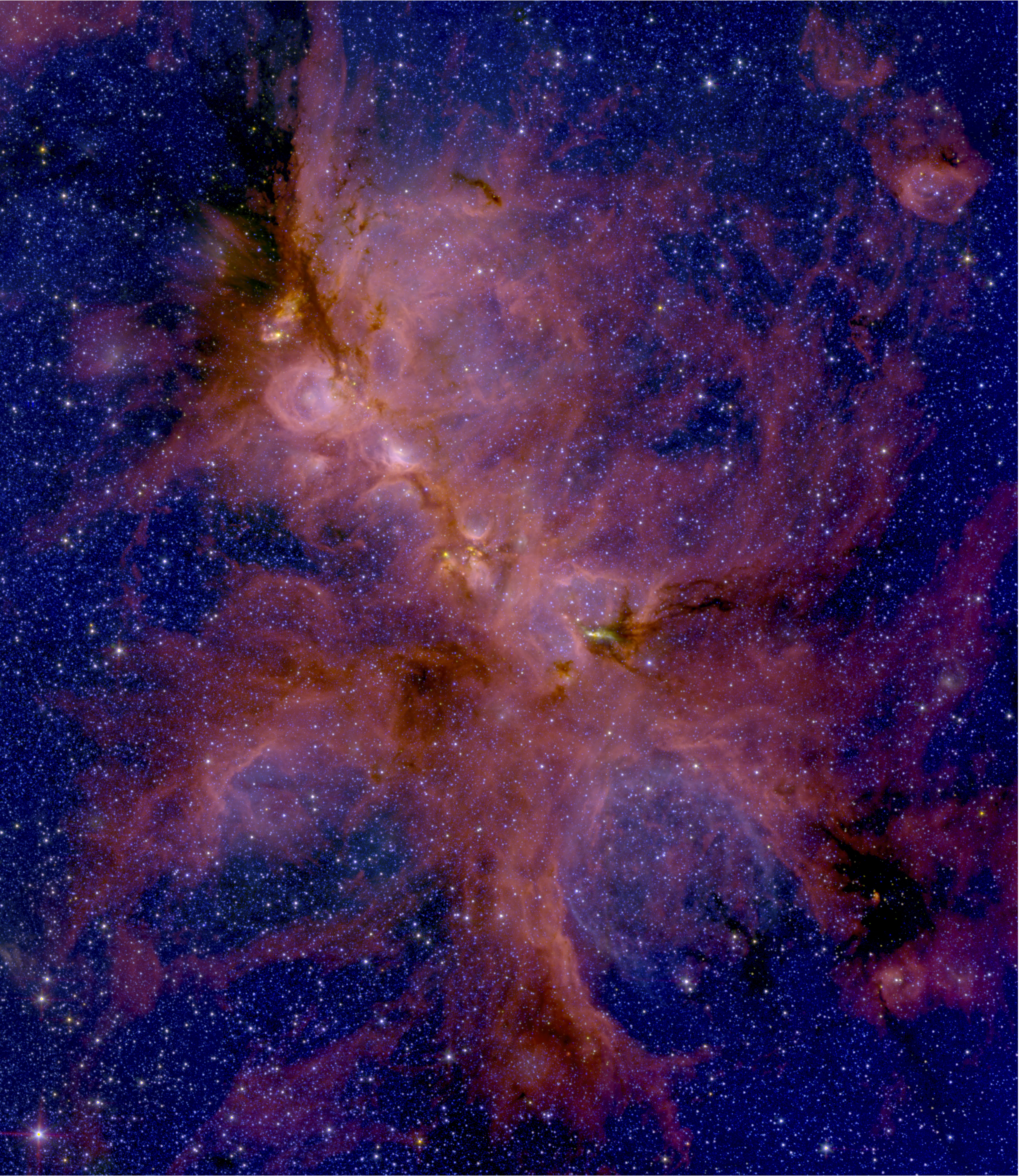
In this composite infrared image of NGC 6334, pink shows gas and dust that make up the nebula, illuminated by bright high-mass stars. Many young stars appear yellow to red and most are found buried within the dark clouds extending from the upper left to the lower right. High-mass stars peek into view by carving out bubbles within the dense clouds of gas and dust that formed them. Click on the image for a high-resolution version. Credit: Sarah Willis, Harvard-Smithsonian Center for Astrophysics; NASA/Jet propulsion Laboratory at Caltech/Spitzer Science Center; Cerro-Tololo Inter-American Observatory/National Optical Astronomical Observatory/Association of Universities for Research in Astronomy/National Science Foundation.
Scorpius is one of the few constellations I can regularly pick out in the summer sky. It often sits low on the southern horizon, with two bright stars marking its pincers and the red multiple star Antares highlighting its long body.
Scorpius, I learned last week, also is home to a star nursery. It’s difficult for amateurs to see, but Iowa State University graduate student Sarah Willis says it’s one of the Milky Way’s most active star-forming regions. In a paper delivered last week at the American Astronomical Society meeting in Indianapolis, Willis described this “star burst,” which is generating tens of thousands of new objects. Read the rest of this entry »
Not long ago, I took the teenager to an Orange Leaf frozen yogurt shop. It was kind of bizarre, facing off against a bank of machines dispensing flavors like birthday cake and lychee. I think the kid got a bit of every kind. He didn’t finish.
What this has to do with Iowa science is the shovel-like plastic spoon I used. I happened to look at the back of the handle and saw something surprising.




 Iowa Science Interface